Downtown Raška was bustling. I hadn’t expected this. I had become so accustomed to the quietness of life atop Kopaonik in the un-season — post ski season and pre summer — this sudden flush of life and people and shops was a mild shock. I carefully navigated the car through the pedestrians spilling off the crowded footpaths onto the road, wandering across diagonally, talking, strolling, conducting business. I spied a parking spot under a line of birch trees. There were several empty spots, which made me suspicious — was I not supposed to park there? The heck with it; it’s a great spot. After waiting for three teenage boys to walk down the centre of the road past me, I pulled in, pleased with myself for finding a shaded spot in town on this warm day.
Outside the Idea supermarket goods hung on racks. Cars were parked higgledy-piggledy on the rough, broken concrete and gravel that the pavement quickly deteriorated into off the main road surface. Weeds grew tall; dogs snuffled through the litter of cans, food wrappings, empty Tetra Pak cartons, cigarette butts, paper. A wealth of fascinating scents to explore, if you’re a dog, and maybe a lucky find of food.
Suddenly invigorated by all this life and activity, I sauntered up ulica Dr Jovanovića (Dr Jovanovića street) to see what this town was like. Although Raška is a grad of over 24,000 inhabitants and the namesake of the district, the Wikipedia entry on it hadn’t mentioned anything of note to look at, except for a couple of photos of a nice-looking central square.
It was early afternoon, about 2 o’clock, and as can be expected in any Balkan settlement at this time of a summer’s day, groups of men sat at tables outside caffe bars drinking coffee or beer and talking, their attention partly on the conversation and partly on what was happening on the street. Like eagles spotting prey, they watched with sharp gaze everyone who passed by. I used to feel like I was running the gauntlet, but I was used to it now and I stared back, smiling inwardly.
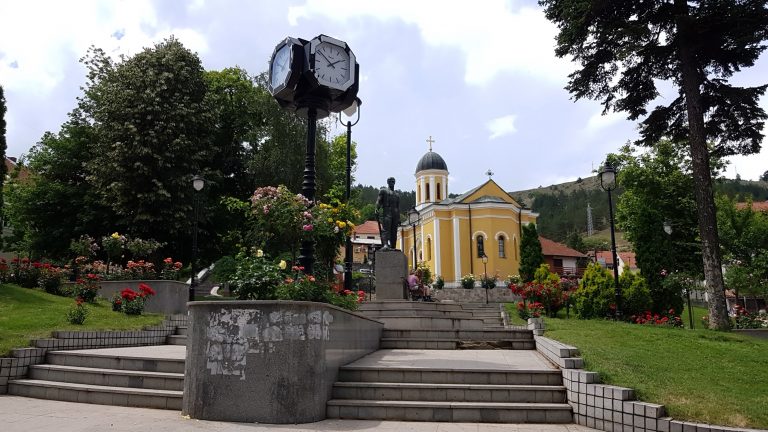
The dusty heat embraced me like a soft cloak. I turned a corner, and there ahead of me was the central plaza, which was indeed lovely. Green and shaded by mature trees, it lay along the hillside, a fountain plashing in its centre. Kids out from school ran among the trees and around the fountain while their parents sat in the shade. Gazing upwards past the four-faced clock, I saw a very pretty canary-yellow church gracing the top of the plaza. Later investigation revealed it to be the Church of St Archangel Gabriel (Crkva Svetog Arhangela Gavrila), in the Serbian Orthodox tradition.
I was actually in Raška on a mission to buy a full-size notebook (sveska) — an item that doesn’t exist on Kopaonik, where I was staying this month — so, after cooling off under the shade of a tree in the plaza, I set off to find a knijžara (bookstore) or some other type of store that sold stationery or school supplies. In Croatia it’s easy; most supermarkets, even small ones (and most are small) have a section of school supplies, along with housewares and other useful things, and they do in Belgrade, too, but down here in south-central Serbia, notebooks don’t seem to be in high demand.
I turned down one street and another, increasingly losing hope of finding a bookstore — I passed a gardening supplies store, computers, cellphones, a tiny ‘bio’ food store stuffed with legumes, dried fruits, organic flours and pastas and whatnot, and loads of sweets — but no knijžara.
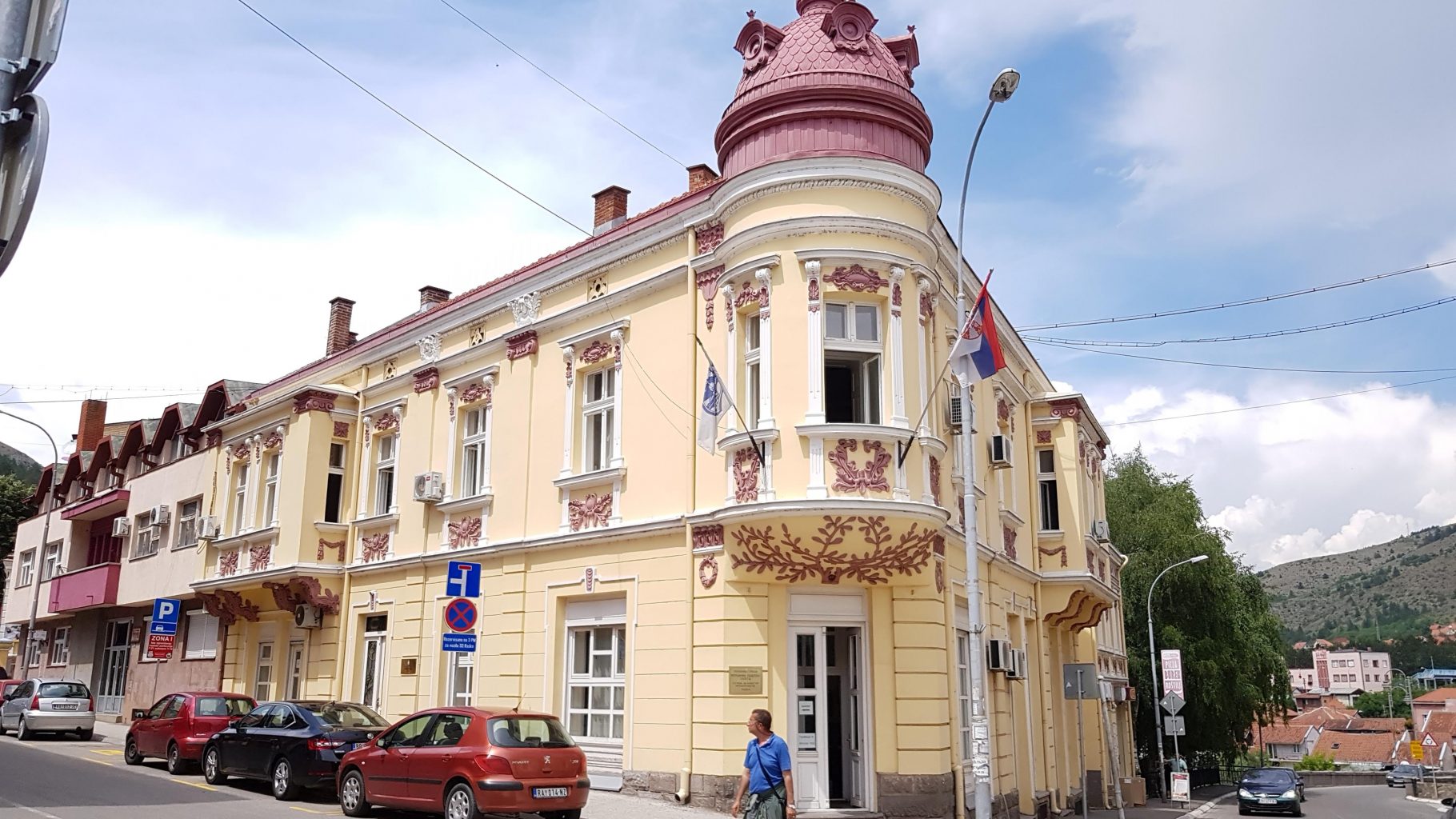
Another turn brought a gorgeous building into view, an elegant remainder of a former era. Dusty yellow with raspberry ice cream-coloured detailing, it sat like an elegant lady among its utilitarian companions. Suddenly, faced with this beauty and grace, my stress over finding a notebook flowed away. Smiling, I looked toward the left and saw a store a bit further up the hill that looked interesting.
Happily I discovered that it was a ‘Chinese store’, a type of shop common across Europe that’s owned and run by Chinese and sells everything from toilet paper to bras, kitchenware, gardening supplies, tools, household goods, stationery, school supplies, men’s, women’s and children’s clothing and footwear, and lots else besides. Yes! At last! I find not only a notebook, but an actual selection of notebooks! Writer’s joy!
A little while later, arms laden with three notebooks (different sizes), a small pack of sticky notes, a roll of packing tape (to tape the shower head to the wall — more about that another time), and a pair of stylish summer trousers, I arrived at the cash register. Except there was no cash register. Instead there was a large calculator festooned with sparkles. Every key was outlined with sparkles, as were the display and the calculator itself. The young woman tapped the sparkly keys and then told me the price. I can at least understand numbers in Serbian, but between her non-native accent and my beginnerness with the language, there was a bit of confusion, but we got there in the end. The total cost: 987 dinara — about €8.50.
Strolling back down the hill to the car, I decided Raška was quite a nice place.
Pro tip: Raška sits pretty much in the middle of a cluster of monasteries: Gradac, Nova Pavlica, Stara Pavlica, Končulić, Tušimlja, Vračevo, and Đurđevi Stupovi (about 3 km from Novi Pazar).